Tap a card to start
A crew member taps their NFC crew card. The kiosk knows who they are and which vessel they're on right now, with no username or password.
Case study · Pyper GO · Unattended retail
Pyper Marine runs small marine-supply stores in the Caribbean where boat crews buy parts with nobody behind the counter. Pyper GO is the kiosk that makes it work: tap a crew card, scan the parts, bill the vessel. No card, no cash, no staff.
Visit Pyper Marine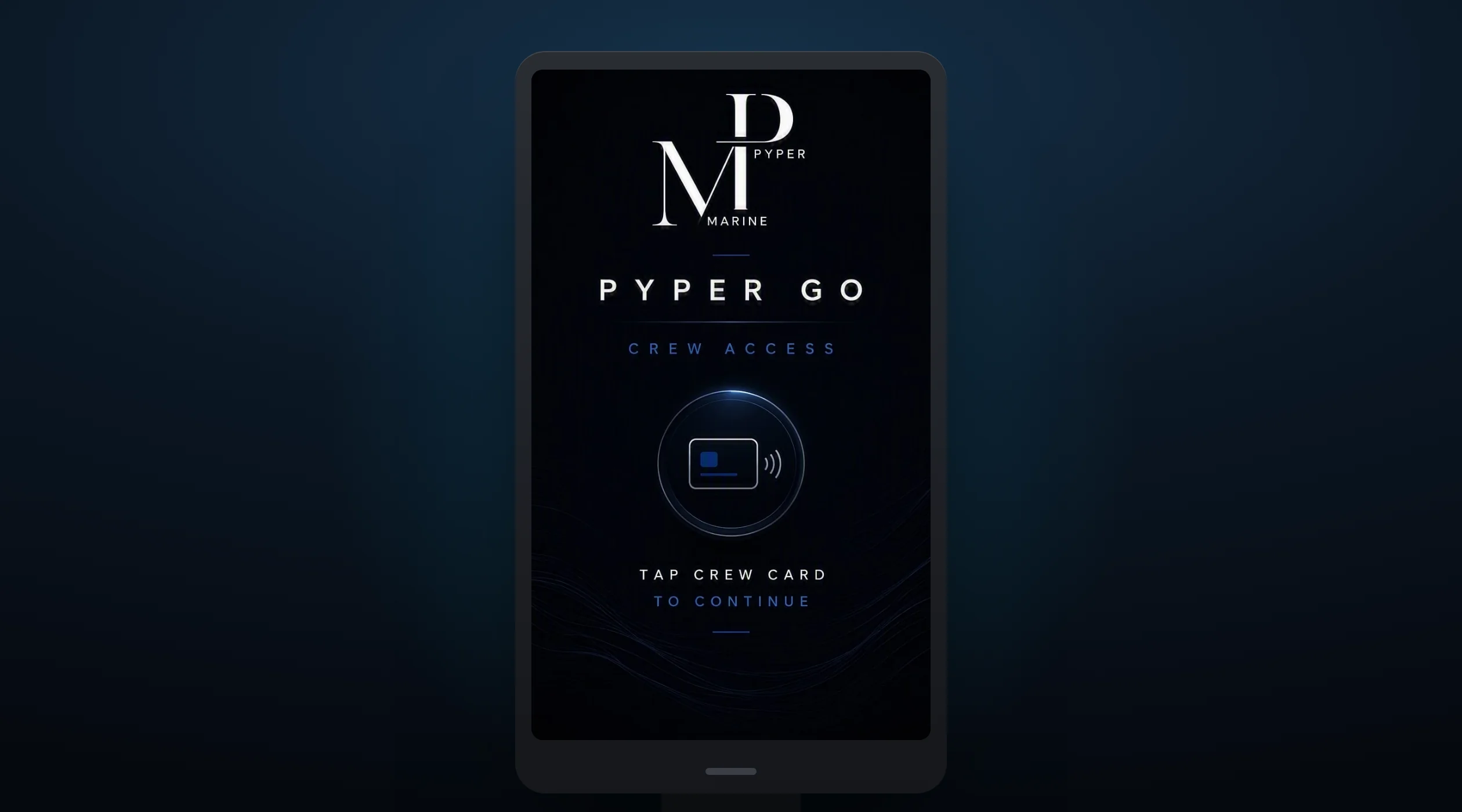
A self-checkout in a supermarket still has someone nearby. Pyper Marine's stores don't. Every purchase has to be identified, priced, billed and taken off the shelf with nobody there to help.
Pyper Marine runs small marine-supply stores in the Caribbean, where crews come in for parts with no staff present. There is no one to take payment and no terminal to take it on.
Crews buy on their vessel's account, and crew move between boats. Every purchase has to land on the right vessel, the one the crew member is on today.
Unattributed sales mean a weekly reconciliation job. The back office should be able to batch-invoice each vessel without chasing who bought what.
We didn't build in the dark for months. A thin version worked on the first day, and every risky assumption met the real kiosk or the real store as early as we could arrange it.
1Discover
We wrote the scope as three objectives and six capabilities, then put every open question to the client as a decision: card only or card plus PIN, how the kiosk resets, whether repair job numbers belong in the first release. Each one was answered and recorded.
2Ship
By the end of the first day, one thin slice worked end to end: tap, scan, bill to the vessel. Every later piece hung off that skeleton, first on the real Zebra hardware, then against the live store and its locations.
3Measure
The plan called for a small database of our own. A read-only probe of the live Shopify store showed it could hold everything we needed, so the database was dropped. The first real order went through the live store before anyone called it done.
Four screens, designed for a standing crew member at arm's length, possibly with wet hands. Large targets, almost no typing, and no payment step at all.
A crew member taps their NFC crew card. The kiosk knows who they are and which vessel they're on right now, with no username or password.
The kiosk's built-in scanner adds each part to the cart as it's scanned. Swipe a line to remove it.
One large button. The order goes to the vessel's company account at its own price list, marked unpaid, ready for the weekly invoice run.
Crews can add a technical ticket number at checkout. It lands on the order as a tag, so repair work can be charged on to the right job.
Each kiosk is linked to its store's location. When an order closes, stock comes off that store, not the warehouse, so inventory stays true across sites.
After 45 seconds idle, a 15-second countdown appears, then the session and cart clear. The next crew member never sees the last one's order.
The kiosk is the easy part to see. The work is in keeping identity, prices, billing and stock correct in Shopify, the store's single source of truth, with nobody on site to fix a mistake.
The service behind the kiosk keeps no database. A card's ID lives on the Shopify customer, and the crew member's vessel is Shopify's own company contact, looked up live on every order, so moving crew between boats takes effect immediately.
Shopify calculates every total, including each vessel's B2B price list. The kiosk shows what Shopify says, so a price can never drift between the screen and the invoice.
If Shopify refuses to move stock to the kiosk's location, the order is still created and tagged for the back office as a worklist. A crew member is never stuck at the till, and nothing goes missing quietly.
It runs on a 22-inch Zebra KC50 Android kiosk. Scanning goes through Zebra's DataWedge, cards through the device's NFC reader. We tested on the unit itself, including fitting a scanner when it arrived without one.
The kiosk and its service share a secret key, and anything else is refused. Linking a kiosk to a store sits behind a staff PIN that locks out for longer after each run of wrong guesses.
Behaviour is written as plain-language scenarios that run as tests. One set of example data feeds the fakes, the Shopify development store and the device, so the three can't disagree.
Work landed in three short pushes: the skeleton in June, the device in August, the live store in September. Twelve decisions are written up with their reasons, and every release passes the same gates.
Pyper GO is deployed to production, and its first real order went through Pyper Marine's live Shopify store. The next step is the rollout: moving crews onto their vessels' company accounts store-wide and locking each kiosk to the app.
“I did not think it was possible to move so quickly from conception of an idea to the actual delivery of the product, in a state that was ready to use on day one. It is the first time I have seen a complex software system being delivered ahead of schedule.”
Thirty minutes with Regardt or Dean. You'll leave with the user problem to solve first, a first release scope and an initial budget range.
Book a free call