It starts with a message
Someone taps a link or scans a QR code, and WhatsApp opens with a message ready to send. Sending it starts the signup, and their personal signup link comes straight back.
Case study · Blu Dot SA · Fibre signup on WhatsApp
Blu Dot SA sells internet to the people other providers turn away. We built the way they sign up: a WhatsApp conversation, three questions and a card payment. No credit check, no paperwork, no debit order. Plus the tools for the agents who sell it.
Visit bludotsa.co.za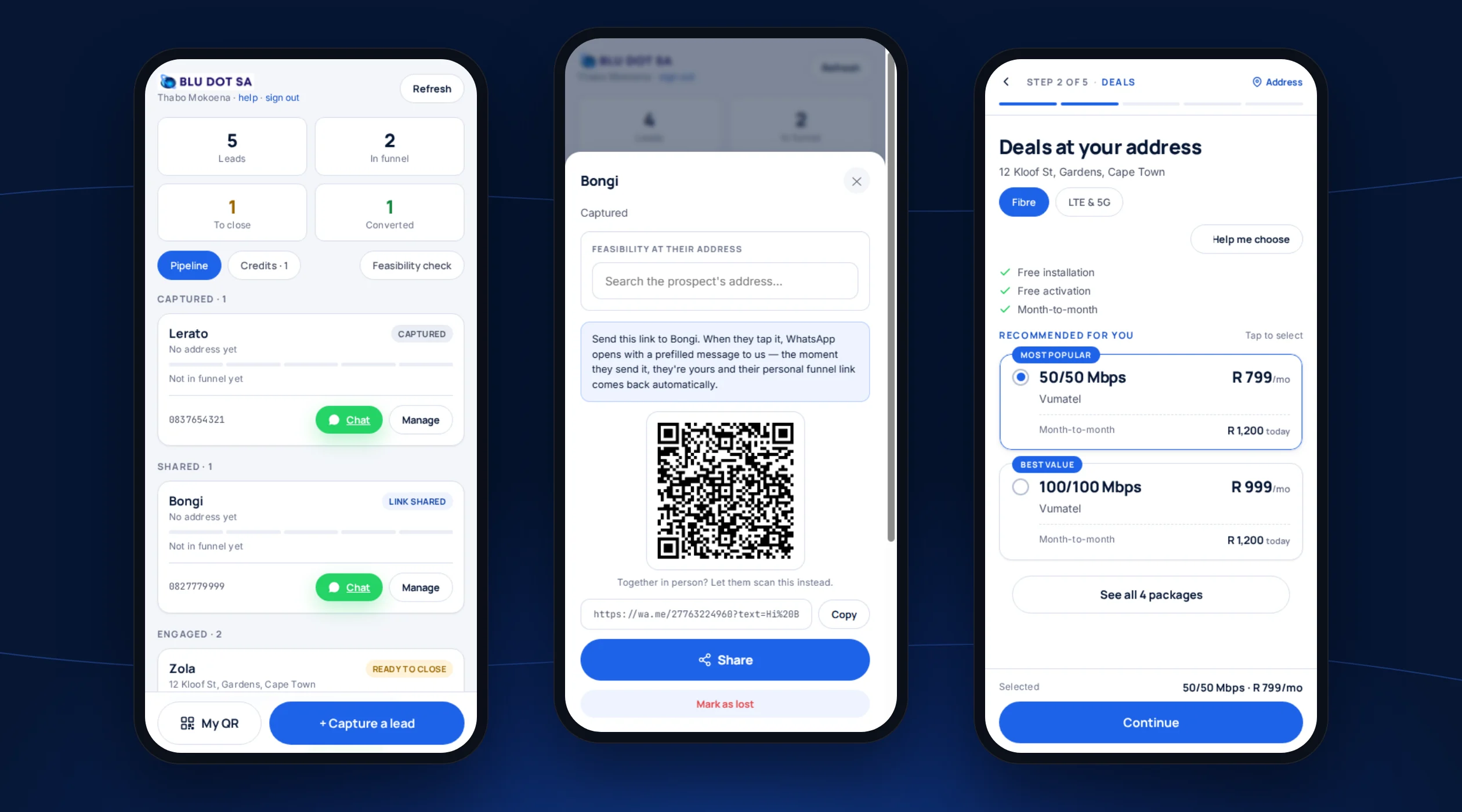
That's Blu Dot's promise. The standard way to sign up for fibre was built to filter customers out, and it was costing Blu Dot the customers it exists for.
Most fibre signups vet credit before anything else. Plenty of people who'd pay every month are turned away at the first step, and Blu Dot's whole promise is to say yes to them.
The white-label store Blu Dot started with asked for a one-time PIN, identity paperwork, an account and a debit-order mandate before anyone could pay. Every gate lost people.
An advertised price that differs from the quote someone gets later is a conversion killer, and a consumer-protection risk.
We started from the checkout Blu Dot already had, removed every step the sale didn't need, and measured what was left.
1Discover
We went through the existing white-label signup end to end and wrote down every step: address, roof pin, deals, add-ons, cart, one-time PIN, identity, account, debit order, payment. Then we asked which ones the sale actually needed.
2Ship
A first version on WhatsApp carried paying customers before the rebuild. The new platform went live in July 2026 and switched to live card payments on its second day. Forty releases followed in nine weeks.
3Measure
Success is two rates from the event ledger: how many shared links become a WhatsApp conversation, and how many people who start the signup pay without help. An automatic reminder that misfired at the wrong people was switched off after two days, until the data says it earns its keep.
Customers never fill in a form or make an account. Agents run their whole pipeline from their phone.
Someone taps a link or scans a QR code, and WhatsApp opens with a message ready to send. Sending it starts the signup, and their personal signup link comes straight back.
The signup checks coverage live at the customer's address, across fibre networks such as Vumatel and Openserve, plus LTE and 5G, and shows only what's available there.
A fixed set of three questions that never branch, block or change the price. Fewer questions converts better.
A once-off card payment through Paystack instead of a debit-order mandate. Identity verification, which the law still requires, happens after the sale, not in the way of it.
Sales agents capture leads, check coverage at any address, share personal links and print QR posters for in-person sign-ups. Every conversion they bring in earns them a credit.
Leads, agents, pricing and the two headline rates in one place. A production report adds the funnel step by step, an agent leaderboard and the reasons leads were lost.
Signing people up is the easy part to see. The work is keeping money, coverage and agents' commission correct across WhatsApp, a wholesale provider and a payment gateway, none of which we control.
Agents and admins have no passwords. Messaging the Blu Dot WhatsApp line from their number is the request to sign in, and the sign-in link is the reply.
Every event and every credit is appended to a ledger that is never edited. The lead list is worked out from it, so any number on a report can be traced back to what happened.
The first agent to reach a person keeps them for a fixed window. A tracked code beats a phone-number match, and losing claims are kept on the lead, so a dispute is settled from the record, not by argument.
Coverage and deals come live from Vox, the wholesale provider Blu Dot sells through, so the customer is shown what can actually be installed at their address today.
Test leads are routed to Paystack's test keys automatically, so the team can try the live system end to end without a real charge.
WhatsApp runs through Keychat, the platform we built and run for restaurants. Blu Dot got a proven messaging layer instead of a new one.
The behaviour is written as plain-language scenarios that run against stand-ins for WhatsApp, Vox and Paystack. Every change has to pass all of them, and a release ships itself from a tag.
We built bludotsa.co.za too, with the legal pages an internet provider needs and a sign-up form for new agents. It has one job.
It shows no prices and runs no coverage check. Every button leads to WhatsApp, so the price a customer sees is always the one they're quoted.
The site replaced an old online store selling electronics, from when Blu Dot still did retail. It now does one job: start a conversation.
In its first four months, the site averaged fifth place in Google results. People search for the signup itself: “blue dot online application” alone brought 29 clicks.
Thirty minutes with Regardt or Dean. You'll leave with the user problem to solve first, a first release scope and an initial budget range.
Book a free call