Search the way agencies brief
Type the brief in plain words. Search matches tracks by meaning, across genre, mood, instrument and more, not just by tag.
Case study · Biblo.tv · Music licensing
Biblo.tv licenses independent African music to productions around the world. Its founder, Markus Wormstorm, is an Annie Award-winning composer, and we've been his technical partner since 2018. The platform does the searching, protecting and licensing, so the business runs on two people.
Visit biblo.tv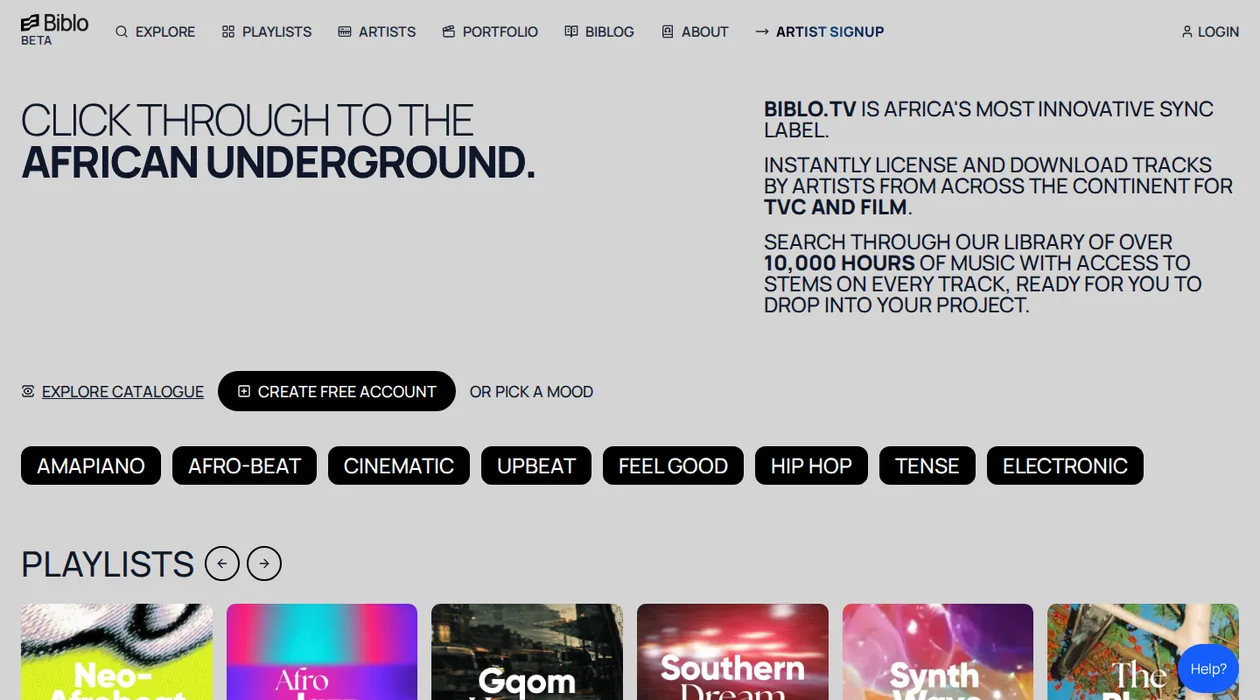
Agencies and studios license Biblo music for TV commercials, streaming series and global sports campaigns. Every brand here has used a track from the catalogue.












Sync licensing has long meant a shortlist by email and a negotiation by phone. That works for a big music house with a sales team. Biblo has two people and a catalogue of 12,000 hours.
Agencies brief music by mood and scene, not by keyword. Tag filters can't answer a brief written the way a director talks.
Which project, what use, which territory, how long: each licence took emails and calls. With two people, that caps the business.
Producers need to hear the real track before they license it. An unprotected master in an audition is a free master.
We don't build everything on the list. Each phase starts by deciding what not to build, then ships, then checks the numbers before the next bet.
1Discover
Biblo runs on a founder's runway, not a corporate budget. Before the current build, a planning phase weighed three candidate next bets against the money available and picked one. Two epics were cut from scope before anyone wrote code.
2Ship
The build was priced at the conservative end of the range and held there. It shipped in focused sprints rather than a drip, so the founder could plan launches around them.
3Measure
Search clicks are up 220% year on year, and a quarter come from the USA and UK. Most searches still name Biblo, which shows where to aim next: people looking for the music, not the brand.
A producer can find a track, hear it, license it and download it in one sitting. Behind them, two people keep the catalogue growing.
Type the brief in plain words. Search matches tracks by meaning, across genre, mood, instrument and more, not just by tag.
Pick the tracks, name the project, choose the use (commercial, TV, film, streaming) and the period, from three months to forever. The download link arrives by email.
Everyone hears watermarked audio. Only licence holders download the masters. Watermarks are added automatically on upload.
Curated and personal playlists, reordered by drag and tagged in bulk, so a shortlist is easy to pass round an agency.
Bulk upload skips duplicates, tags apply in bulk, and long jobs show their progress. Failures stay on screen until someone deals with them.
A calculator holds the full rate card: 12 categories, four client tiers, blanket deals and territories. Benchmarked against the published industry rates.
The hard parts are finding music by meaning and protecting it until it's paid for. Both run on their own services, deployed together, so the founder never has to think about them.
Each track's metadata is written out as a sentence (its genres, moods and instruments) and turned into a 768-dimension vector by a Python embedding service. Elasticsearch finds the nearest tracks to a brief, so plain words land on music that fits.
On upload, ffmpeg draws the waveform and stamps the watermark. Originals are served only to accounts allowed to read them, and admins can switch between the two to check the watermark.
A download link only exists with a licence behind it: the project, its uses and the period. 324 were issued self-serve by May 2026.
Uploads and re-indexing run as tracked jobs that report progress. A failure stays visible until someone dismisses it. The rule came from a real bug, where processing failed after upload and nobody knew.
Duplicate tags, orphaned images, playlist clean-up and track counts are fixed by scripts, not by hand, so the catalogue stays tidy without a third person.
GitLab CI builds the image and Helm installs it to Kubernetes, with Elasticsearch and the embedding service alongside. Only the main branch deploys to production.
Biblo moves when the business is ready to. Work lands in concentrated sprints, with the biggest in late 2024 and each September since. Every release goes to production from the main branch through the same pipeline.
“Codeswop is part of the team. I feel like I have super powers with them by my side. We have worked together since 2018, when the project was in its infancy, and today our product is stronger than ever and competing on the world stage.”
Music licensed through Biblo has travelled. Kidwithamatch's “Man on the Hill” scored Ogilvy Johannesburg's #ShaveToRemember for Philips and the Nelson Mandela Foundation, a campaign that went on to win a Loeries Grand Prix. Today a quarter of Biblo's search traffic comes from the USA and the UK.
Thirty minutes with Regardt or Dean. You'll leave with the user problem to solve first, a first release scope and an initial budget range.
Book a free call