An instant quote, no haggling
Add the pickup, the drop-off and the package size, and get a price based on distance and size. Door to door anywhere in South Africa, often same-day between major cities.
Case study · PackHitch · Peer-to-peer delivery
PackHitch sends parcels with verified drivers already travelling the route, anywhere in South Africa. Two self-funded founders came to us with a big brief. We asked what the first year actually needed, built that, and helped them launch it. It's live, with paying customers.
Visit packhitch.co.za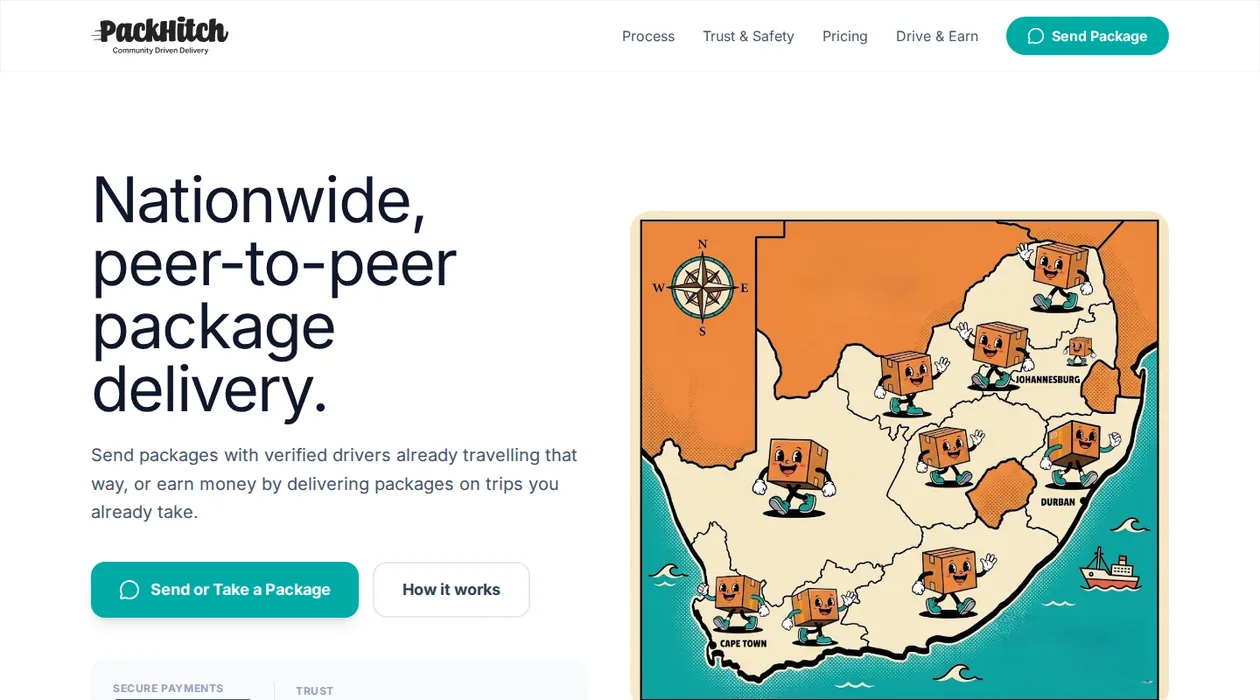
The brief was defensible, ambitious and comprehensive, and far bigger than the problem PackHitch had to solve in its first year. It described everything the platform might one day do.
We asked a different question: what's the smallest version that earns the right to build the rest? Three questions the brief hadn't asked reshaped the scope.
The brief listed about two dozen capabilities. We asked which of them, shipped on day one, would say yes or no about whether the business works. That list was a third the length.
The brief assumed the infrastructure a 100,000-customer business needs, before the unit economics were proven. We kept room for it in the architecture and built what year one needed.
Three integrations had no hard dependency in the first year. Nothing would break without them, so they were deferred until customers ask for them.
A smaller first release didn't mean cutting corners on engineering. It meant answering the right questions before anyone started building.
1Discover
We asked one question of each item in the scope: what breaks if we drop this? The core delivery workflow stayed. Three large secondary epics broke nothing in year one and were deferred. Two more became small phases with a decision point on real adoption data.
2Ship
Each piece was estimated as a range, not a single hopeful number, and the ranges were run through a simulation to see the realistic spread. The build went out in phases, each with a fixed scope and a gate with a risk review before the next began. The gates caught two scope drifts before they grew.
3Measure
The deferred epics wait on customer signal. Some have since been built, because real use demanded them. Several are still deferred, and none are missed.
Handing a parcel to someone you've never met only works if every step earns trust: who the driver is, what it costs, and when the money moves.
Add the pickup, the drop-off and the package size, and get a price based on distance and size. Door to door anywhere in South Africa, often same-day between major cities.
Verified drivers travelling the route offer to carry the parcel. Senders compare each driver's profile, verification and ratings before they accept.
Every driver passes South African ID validation, a driver's licence check, a live selfie match and a criminal background check. Senders declare contents, and some goods are not allowed.
The sender pays through Paystack on accepting an offer, by card, SnapScan or Instant EFT. The driver is paid to their bank account once the delivery is complete.
The receiver confirms delivery on WhatsApp, then the sender and the driver rate each other. Ratings follow every driver into their next offer.
PackHitch installs from the browser to the home screen, so nobody has to download an app to send their first parcel.
A small, deliberate stack. It reuses what we already run, like our WhatsApp platform, instead of building it again from scratch.
A Meteor and React progressive web app with a service worker, served behind Cloudflare. It warns people who open it inside Facebook's or Instagram's browser, where it can't install.
Payment is taken when the sender accepts an offer and paid out to the driver after delivery is confirmed. The payment integration was the most uncertain part of the plan, so it was scheduled with room for surprises.
Drivers apply in a WhatsApp form running on Keychat, our own WhatsApp platform. Applications land in the back office through an n8n webhook instead of documents collected by hand, and the pitch runs in three versions to see which converts.
The architecture leaves room for the scale-grade build the brief asked for. It's deferred, not designed out, so growth won't mean a rewrite.
A marketplace lives or dies on its first drivers. So we helped the founders plan the launch as well as build the product.
A marketplace needs drivers before it has demand. The Founding Driver offer refunds the verification fee as credit on a driver's first delivery: a light quality filter, without the friction.
A playbook for 16 channels, a bank of captions, message templates and WhatsApp links tagged per channel, so the founders can see which channel brings drivers in.
Big logistics firms were cut: slow sales cycles, and their drivers are salaried, so moonlighting is a conflict. The effort went to community groups and partners whose drivers are independent and want the income.
“It was important for us to partner with a company that knows what it takes to build a business. Over and above the software product they developed, they are a crucial part of our day to day operations and bring much more than just software knowledge.”
Thirty minutes with Regardt or Dean. You'll leave with the user problem to solve first, a first release scope and an initial budget range.
Book a free call